What this service covers
Radon testing for purchases, sales, post-mitigation checks, and plain peace of mind. Devices are placed by Ohio-licensed radon testers following the Ohio Radon Measurement Protocol in OAC 3701-69-07, and the written report lists device locations, start and stop times, license numbers, weather, and whether a mitigation system was running.
Typical pricing
$150-$300
Pricing varies by job specifics. Free phone or on-site quotes; fixed pricing once the technician has assessed the job.
Short-term, long-term, and continuous monitors in Columbus
Every radon test answers one of two questions: what is the level right now, under controlled conditions, or what is it across a year. Ohio's protocol defines a short-term test as anything from 48 hours to 90 days, though most run two to seven days using charcoal canisters, liquid scintillation vials, electret ion chambers, or continuous monitors. A long-term test runs longer than 90 days, typically with an alpha-track detector or an electret, and comes closest to the year-round average the EPA's risk estimates describe.
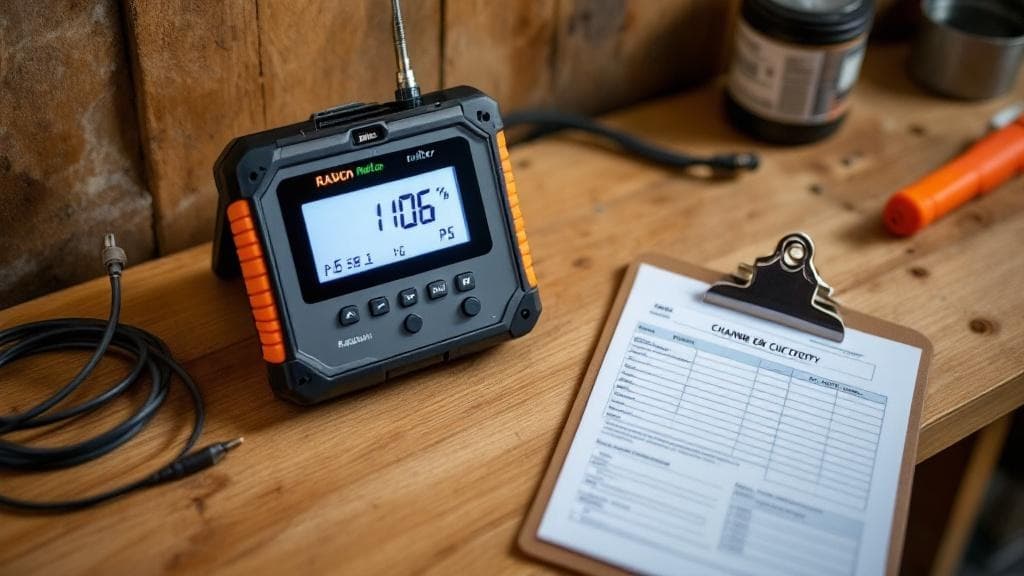
For a home sale Ohio allows two routes, both at least 48 hours long: two passive devices set side by side, 4 to 5 inches apart, or a continuous monitor recording 48 straight hours of usable data. The first four hours of monitor data may be dropped, but cutting data out of the middle voids the test. Continuous monitors report hourly readings, which show whether a result was steady or spiked with a storm front.
A professional short-term test runs $150 to $300. For your own home, a charcoal kit costs $15 to $30, and Ohio homeowners can order one free through ohio.radon.com. The comparison page sets the two approaches side by side.
Placement and closed-house rules under the Ohio protocol
A radon number is only as good as the conditions behind it, and Ohio writes those conditions down. The device goes in the lowest level suitable for occupancy, in a room people can actually use: not a kitchen, bathroom, laundry room, closet, crawl space, or sump. It sits 20 inches to 6 feet off the floor, at least a foot from exterior walls, 3 feet from doors, outside windows, and vents, 4 feet from heat sources, and 10 feet from the sump. A level over 2,000 square feet gets an extra device for each additional 2,000.
For any test shorter than 96 hours, closed-building conditions begin at least 12 hours before the start: windows shut, exterior doors used only for normal coming and going, heating or cooling running as usual, and no whole-house fan. Ceiling fans, dehumidifiers, humidifiers, air filters, and window units stay off within 20 feet of the device. A vacant house keeps its HVAC running near 72 degrees. Short tests are not run in severe storms or sustained winds of 30 mph or more, so the tester checks the forecast first.
In a sale, the buyer, seller, occupant, or agent signs a noninterference agreement, and a notice that a measurement is in progress is posted at every entry. Those two steps are what let a result stand up if anyone challenges it.
What Ohio's testing strategy says to do with a result
For a house that is not changing hands, Ohio recommends starting with one short-term test in the lowest livable area of each foundation type, so a split-level gets a device in the basement, one in the room over the crawl, and one on the slab. Under 4 pCi/L, nothing further is needed beyond a retest in two years or after renovations. From 4 to just under 8, a second short-term test or a long-term test clarifies the picture. At 8 or higher, run a second short-term test and decide on the average of the two.
For a sale the rule is shorter: a result of 4.0 or higher means fix the home. The EPA adds a band below that, recommending that owners consider a fix between 2 and 4 pCi/L, since no level is free of risk.
Every Ohio report must arrive within 30 days of pickup, or within 14 days of lab results, and must list the start and stop times, the device and serial number, the Ohio license numbers of whoever placed and collected it, the lab's license number where one was used, any tampering or severe weather, and exactly where each device sat. That last item matters more than it seems: follow-up tests go in the same spot, so a clear location record is what makes next year's result comparable. See what a 6.5 result means.
Why the heating season is testing season in Central Ohio
Franklin, Delaware, Licking, Fairfield, and Madison counties sit in IECC climate zone 5A, a colder zone than Cincinnati's 4A, so Central Ohio houses stay shut and heated for a long stretch of the year. Warm air rising through a closed house leaves its lowest level at slightly lower pressure than the soil, and that is the condition that pulls radon in hardest. A result taken between November and March is the stronger basis for a decision than a July snapshot, and a long-term device set out in the fall and collected after winter captures the full swing.
January is National Radon Action Month, when interest and free kits both peak. The region is not short on test data: an American Lung Association analysis of CDC figures found Franklin County logged 16,142 pre-mitigation tests from 2008 to 2017, the most in Ohio, and Licking County had the state's highest testing rate at about 66 tests per 1,000 housing units. Plenty of neighbors have tested; the only number that matters for your family is your own.
The Ohio Department of Health recommends retesting single-family homes every two years and after significant renovation, and multifamily, school, and commercial buildings every five years. Book a test for your Columbus home or read the heating-season plan.
Service area
Radon Testing is available across Greater Columbus and Central Ohio. Per-suburb pages: