What this service covers
Active sub-slab depressurization (ASD) systems, designed and installed custom to your foundation type: slab, basement, or crawl space. Every install is verified post-completion with a 48-hour follow-up test. Workmanship warranty terms confirmed in writing before work begins.
Typical pricing
$1,200-$2,400
Pricing varies by job specifics. Free phone or on-site quotes; fixed pricing once the technician has assessed the job.
Active sub-slab depressurization, the EPA-preferred Columbus mitigation method
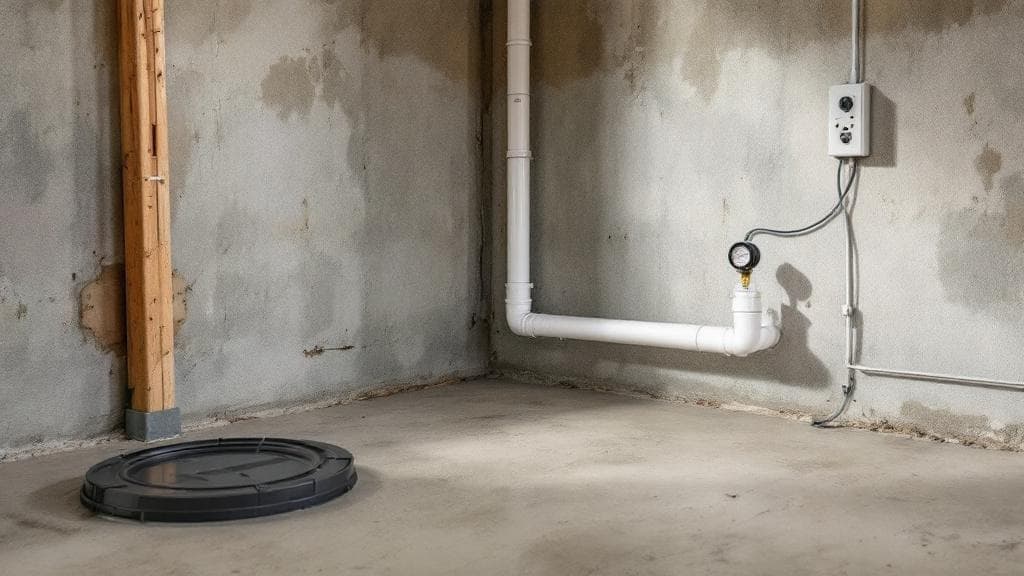
An active sub-slab depressurization (ASD) system creates a continuous low-pressure zone beneath the slab using an inline radon fan and a sealed 4-inch PVC stack routed from the suction pit through the home and out above the roofline. That negative pressure pulls soil gas through the suction pipe before it can enter the conditioned space, dropping indoor radon by 80-99 percent across hundreds of Greater Columbus installs.
ASD is the EPA-preferred method per the Citizen's Guide to Radon and the standard approach codified in ANSI/AARST CCAH-2020-0523, the consensus mitigation standard. Every system here is designed to that standard: properly-sized fan for the suction-pit volume, sealed slab penetrations, dedicated 15-amp electrical disconnect, U-tube manometer for ongoing performance verification, and code-compliant exterior termination 12 inches above the roofline and at least 10 feet from any operable window.
The design phase matters as much as the install. A typical pre-1980 Columbus basement has 5-8 distinct radon entry paths beyond the obvious slab cracks: sump pit penetrations, plumbing rough-ins, expansion joints between slab and foundation wall, mortar joints in stone basements, settled cracks radiating from the slab center, and sometimes the floor drain. The on-site assessment maps each one and writes the scope against the actual home, not a one-size-fits-all template. Crawl-space homes get a different approach (sub-membrane depressurization with a reinforced 12-mil polyethylene barrier) priced at $1,800-$3,500 because the membrane install is the bulk of the labor.
Central Ohio geology and Franklin County radon zone reality
Columbus sits on Devonian-period limestone and shale (the Columbus Limestone, the Olentangy Shale, and the Ohio Shale), a geology rich in trace uranium-238 that produces measurable radon as it decays. Franklin County, plus Delaware, Licking, Fairfield, Union, and Pickaway counties across the metro, are all designated EPA Radon Zone 1, the highest-risk classification meaning predicted indoor screening levels at or above 4.0 pCi/L. Roughly 1 in 3 Franklin County homes that test exceed the action level per Ohio Department of Health data.
Specific neighborhoods consistently test higher. Pre-1950 stone-basement housing in Clintonville, Bexley, Grandview Heights, and the older sections of Worthington shows averages of 6-12 pCi/L pre-mitigation; many homes in those clusters have measured above 14 pCi/L. Newer slab-on-grade construction in Dublin, New Albany, and Powell typically tests 1.5-4.0 pCi/L because of better soil-gas-tight construction practices and post-2010 RRNC (radon-resistant new-construction) passive stacks that many builders include by default. Delaware County homes in Lewis Center, Sunbury, and Galena track Franklin County levels because they sit on the same central Ohio bedrock, just north of the metro core.
For Columbus homes built before 2010 without a passive stack, mitigation is almost always straightforward ASD with one suction point. Homes with finished basements, walkout basements into a ravine, or split-level foundations may need two suction points (multi-zone install) to achieve coverage; the mitigator identifies those during the on-site assessment and quotes against the actual scope. The post-mitigation reading goal is below 2.0 pCi/L (the EPA "consider mitigation" threshold halved), not just below the 4.0 action level.
Closeout package, warranty terms, and post-mitigation verification
Every mitigation install ends with a documented closeout package delivered within 48 hours: ANSI/AARST MAH-2023 conforming post-install verification report, manufacturer fan spec sheet (typically RadonAway RP-145 or Festa AMG-150), system schematic showing suction-point location and stack routing, dedicated electrical circuit specification, U-tube manometer reading at install completion, and the credentialed mitigator's NRPP or NRSB certification page.
Warranty structure has three components with separate windows. The install workmanship warranty is written and covers sealing, routing, mounting, and electrical work, typically 5 years. The fan itself carries a manufacturer warranty: RadonAway RP-145 is 5 years, Festa AMG-150 is 10 years; a failed fan is replaced under warranty at no labor charge for the warranty period of whichever fan was installed, and we make sure that commitment is honored. The post-install verification testing (48-hour retest) is included in the original quote and performed at no additional charge; if the post-mitigation reading exceeds 2.0 pCi/L on that verification, the return trip to troubleshoot is at no charge. Typical fixes are additional sealing work or a fan upsizing.
We also schedule a no-cost 12-month follow-up retest because radon equilibrium can drift over time as the home settles, weather patterns shift the soil-gas pressure, or sealing degrades. That 12-month retest catches drift before levels climb back near the action level. Cheaper non-credentialed installers often skip the 12-month retest; without it, drift cases go unaddressed for years. The retest is the structural value of a credentialed install.
What changes a Columbus radon mitigation quote
The $1,200-$2,400 range covers the bulk of Greater Columbus basement and slab installs. The cheap end ($1,200-$1,500) is newer slab-on-grade homes with exterior wall routing on an unobstructed elevation, single suction point, and minimal sealing scope. The middle ($1,500-$2,000) is older basements with some crack sealing and an interior chase routing through a closet up to the attic. The high end ($2,000-$2,400) is stone or block basements with substantial mortar-joint sealing, two-zone homes needing two suction points, or homes where the optimal stack routing requires a second-floor closet sleeve.
Crawl-space mitigation is its own pricing tier ($1,800-$3,500) because of the vapor-barrier and encapsulation work. A typical crawl-space install removes existing fiberglass batting, addresses standing water if present, lays a continuous 12-mil reinforced polyethylene barrier sealed to the perimeter walls, installs a sub-membrane depressurization manifold, and routes the stack up through the home. The crawl-space scope often pairs naturally with moisture-control work that pays for itself in basement humidity reduction and floor-comfort improvement.
Watch for two pricing red flags from non-credentialed competitors. First, "starting at" quotes without an on-site assessment mean the actual quote will be substantially higher once the contractor sees the home; reputable Columbus mitigators write fixed-price quotes after visiting. Second, any contractor unwilling to put the price in writing before work begins is a flag for scope-creep and change-order pressure during install. Columbus-area standard is a written, fixed quote good for 30 days, signed before any work happens.
Service area
Radon Mitigation Systems is available across Greater Columbus and Central Ohio. Per-suburb pages: